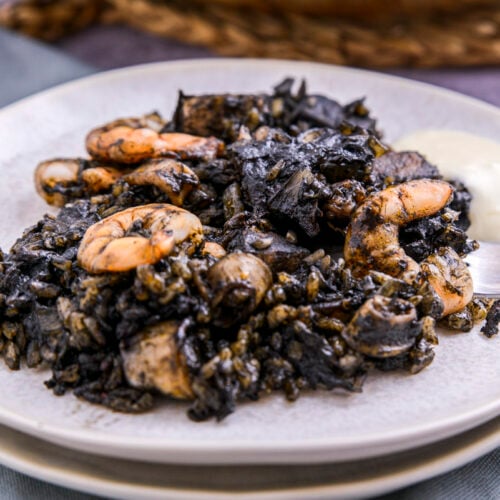
Arroz Negro
Arroz Negro - sometimes also called Squid Ink and Seafood Paella - is a delicious Spanish rice dish that is commonly eaten for lunch. It's made with lots of fresh seafood, vegetables, rice, and fish stock, and it gets its color from the addition of squid ink!
Servings 4
Ingredients
- 7 ounces calamari and/or cuttlefish, cleaned
- 1 red tuna steak , (about 5 ounces / 140 grams)
- 2 large tomatoes, ripe
- 2 garlic cloves
- 2 tablespoons pimiento choricero meat (or ñora pepper meat), alternatively 1 teaspoon sweet paprika powder
- 1 large white onion
- 4 tablespoons olive oil
- 2 2/3 cups fish stock, (21.6 fluid ounces)
- 4 tablespoons squid ink
- 1 teaspoon salt, or to taste
- 11.3 ounces short-grain rice
- 7 ounces prawns or shrimp, cleaned
- allioli and lemon, optional (to serve)
Instructions
- Cut the calamari (and/or cuttlefish) and tuna steak into bite-sized pieces. Set aside.
- Cut the tomatoes in half and grate the flesh into a bowl, discarding the skins. Set aside.
- Prepare the “majada” for the sofrito: Peel the garlic cloves and add them to a mortar with some of the salt. Add the pimiento choricero meat (or paprika powder and some olive oil) and smash until you have a smooth paste. Set aside.
- Peel the onion and dice it as finely as possible. Set aside.
- Heat half of the olive oil in the paella pan or large shallow skillet over medium-high heat. Add the calamari/cuttlefish and tuna pieces and cook for about 2-3 minutes on all sides. Remove them from the pan and set aside.
- Add the rest of the olive oil to the pan. Then add the diced onion and sauté over medium heat, stirring frequently, until it turns golden and fragrant.
- Add the garlic and pimiento choricero mixture to the pan, along with the grated tomatoes. Mix well and cook for 5-6 minutes until most of the liquid has evaporated and the sofrito has a slightly darker color.
- While the sofrito is cooking, dissolve the squid ink in a cup of the fish stock. Set aside.
- Return the calamari/cuttlefish and tuna to the pan and mix well with the sofrito.
- Add the stock and the dissolved squid ink to the pan. Add the salt and bring everything to a boil.
- Once boiling, add the rice and distribute it evenly with a wooden spoon or spatula. Gently shake the pan to help level the rice. From this point, avoid stirring the rice.
- Cook over high heat for 10 minutes, then lower the heat to medium and cook for an additional 3 minutes.
- Add the prawns, slightly pressing them into the rice and stock using the wooden spatula. Continue cooking for 2 more minutes.
- Remove the pan from heat. Cover it with a lid and a few kitchen towels to trap the heat and steam (if needed - see notes section). Let it rest for 5 minutes to allow the rice to finish cooking.
- Uncover and serve on plates or eat directly from the pan with allioli and lemon (optional).
Notes
- Use a mix of calamari and cuttlefish if you can find both. Otherwise, use whichever you have available.
- Use short-grain rice, especially Bomba, Sendra, or Calasparra. If you can’t find any of these, choose rice that is white, short, and round. Italian risotto varieties work well, especially Carnaroli. Don’t use sushi rice and avoid basmati, long-grain, and parboiled rice.
- You don’t need extra virgin olive oil for this recipe, refined olive oil is fine. Avoid any other vegetable oil since it would change the flavor drastically.
- The majada (mortar and pestle paste) can be made with garlic and either choricero pepper meat or ñora pepper meat. If you can’t find either the pepper meat or the dehydrated peppers, you can use sweet paprika powder and a teaspoon of olive oil.
- If you can only find dried choricero or ñora peppers, simply rehydrate them with hot water while you are sautéing the onions. Then scrape their meat with a knife and add it to the mortar.
- The squid ink adds color and flavor to the dish. It is thick (almost like a thick cream) and quite salty, which is why it’s very important to go easy on any extra salt you add. You can taste the fish stock and squid ink once they're mixed and adjust the salt you add accordingly.
- The amount of heat and the size of the pan are crucial. This dish is usually made in a wide and shallow pan, so use a large burner. Try to avoid using a pan that is larger than your burner, or the rice may not cook evenly.
- Heat control is crucial. Once the rice is added, start with a higher heat, then reduce it to medium-low or low, and then simply let it rest (usually covered) with the heat switched off.
- To get the perfect socarrat (caramelized crust on the bottom of the pan) without burning the bottom: Once it starts to make the crackling sound, taste a few grains of rice.
- If they are halfway cooked but still a bit hard, lower the heat so the remaining stock does not evaporate too quickly. Cook for 2-3 more minutes at the lower heat and then stop and let it rest. Taste it first to check if the rice is fully cooked (let it rest uncovered) or a bit hard still (let it rest covered).
- If the rice is almost cooked when the sound starts, let the rest of the stock evaporate by cooking for 2 more minutes at the higher heat. Then let it rest uncovered.
Nutrition
Calories: 658kcal | Carbohydrates: 82g | Protein: 35g | Fat: 21g | Saturated Fat: 3g | Polyunsaturated Fat: 4g | Monounsaturated Fat: 12g | Trans Fat: 0.01g | Cholesterol: 192mg | Sodium: 1430mg | Potassium: 910mg | Fiber: 5g | Sugar: 5g | Vitamin A: 1891IU | Vitamin C: 18mg | Calcium: 143mg | Iron: 4mg
This nutritional information has been estimated by an online nutrition calculator. It should only be seen as a rough calculation and not a replacement for professional dietary advice.
