Stollen, sometimes also called German Christmas Bread, is one of the most classic German Christmas recipes and one I try to make every year.
This yeast bread is packed with candied citrus peel, raisins, and almonds and finished with lots of melted butter and a thick coat of powdered sugar. It’s also sometimes referred to as Christstollen (because it is eaten at Christmas).
If you want to bake a Stollen for this holiday season, you’d better start early since it tastes best if it can “ripen” for a couple of weeks before slicing! It has a few steps, but it’s not difficult to make once you break it down.
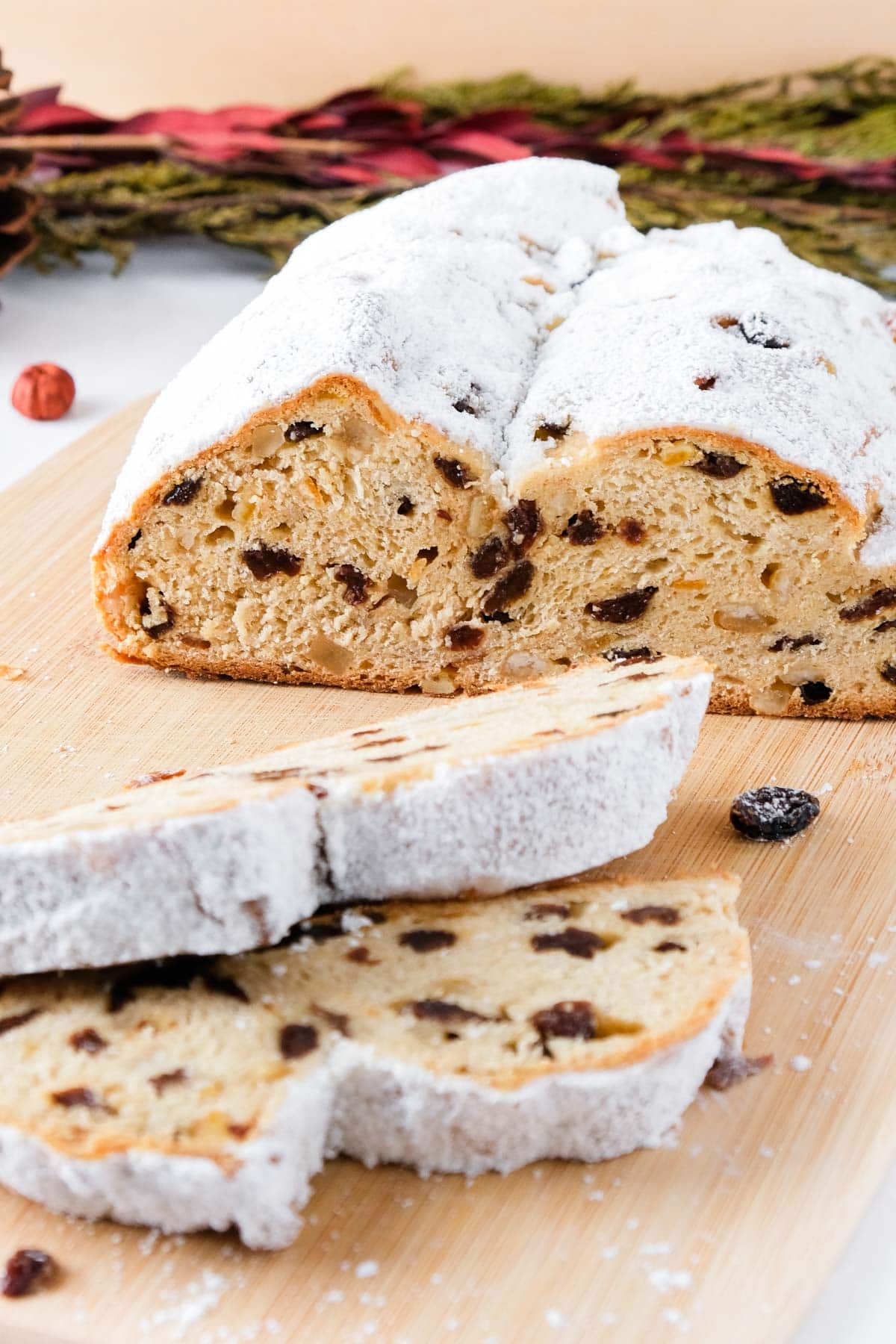
If you are looking for an easy Stollen recipe, our recipe is fairly straightforward. Just be patient… you’re working with yeast, and the dough will have to rise on two occasions.
If you’d prefer to skip the yeast (and the ripening time), you can make a Quarkstollen. You can find the recipe in our German Christmas eBook.
There are also a number of Stollen recipe variations. We don’t include marzipan in our Stollen, but you certainly can (we’ll explain how in the recipe tips below).

Bring German Christmas magic to your kitchen
33 authentic German Christmas recipes, 14 of them exclusive to this eBook. These are the treats, meals, and traditions I grew up with in Germany.
The History of German Stollen
This Christmas bread has a long history dating back to medieval times. It was first mentioned in writing in 1474, but at that time, Stollen was more of a plain bread made with flour, yeast, and water.
In fact, the Catholic Church didn’t allow bakers to use butter during Advent (which was a time of fasting). The Elector of Saxony and his brother eventually wrote to the Pope to get this law changed.
In 1491, the Pope granted what is known as the “Butterbrief” (butter letter), and bakers in Saxony (where Dresden, Germany, is located) were permitted to use butter in their Stollen without being fined (source: Dresdner Stollen)! The butter made the Stollen taste much better.
The Stollen that is mainstream today is the version filled with fruit and/or nuts (among other things). Dresden, Germany is still the city most associated with Stollen and there are just over a hundred bakeries in and around the city that can make the “official” Dresdner Christstollen.
Fun Fact: Each year at the Stollen Festival in Dresden, bakers make a giant Stollen and parade it through the city before cutting it with a very large knife.
Ingredient Notes
- Candied citrus peel – You can use store-bought candied citrus peel, but it’s also easy to make yourself. You can follow our recipe for candied orange peel and candied lemon peel.
- Raisins – Classic Stollen ingredient. Regular raisins and sultanas both work well.
- Ground almonds – Almond meal or almond flour also works.
- Rum – Alternatively, use apple juice for an alcohol-free option.
- Milk – Low-fat and whole milk both work well.
- Yeast – Use instant or active dry yeast. Make sure that it’s fresh, otherwise the dough may not rise.
- Granulated sugar – Some for the yeast and some for the dough.
- All-purpose flour – Regular all-purpose flour for the dough.
- Lemon zest – Preferably from an organic lemon.
- Ground cinnamon – Use ground cinnamon that is relatively fresh for the best taste.
- Ground nutmeg – Adds some extra flavor; don’t skip it if possible.
- Ground cardamom – Often included in Stollen, but if you don’t have any, it’s okay to skip.
- Salt – Regular table salt; balances the yeast.
- Egg – For the dough; make sure it is at room temperature.
- Vanilla extract – Adds some extra flavor; use real vanilla extract as opposed to artificial vanilla extract if you have it.
- Butter – Use unsalted butter; the butter for the dough should be at room temperature and the butter for brushing on at the end should be melted.
- Powdered sugar – Also called icing or confectioners’ sugar. Gives the Stollen its classic look at the end.
Recipe Tips
- Make sure that the egg and butter for the dough are at room temperature since you are working with yeast. Otherwise your dough might not rise as desired.
- If the yeast mixture doesn’t become slightly foamy or at least smell yeasty after a few minutes, the milk may have been too hot, or the yeast may have expired and your dough will not rise.
- The weight of candied citrus peel can vary quite a bit, so use 1 cup (240 ml) as a guideline even when using metric measurements.
- Marzipan is a popular Stollen addition. When rolling out the dough, simply add a long, thin log of marzipan lengthwise on top of the dough and then fold up one side around the marzipan as explained above. When cutting it later, each slice will have a small piece of marzipan in the middle. You can use our marzipan recipe.
- If the Stollen gets too dark during baking, loosely cover it with some aluminum foil.
- Stollen made with yeast tastes best after ripening for about 2 weeks. If you’re short on time, you can make Quarkstollen without yeast (recipe in our Christmas eBook).
Get a Taste of Europe
Join 3000+ readers and get European recipes and family favorites to your inbox every week.
You can unsubscribe anytime. No spam. For more details, review our Privacy Policy.
How to Make Stollen – Step by Step

If your orange and lemon peels aren’t cut yet, cut them into small pieces. We like to cut them with a knife over a food processor so they don’t get too small.
You should still be able to see the peel in the baked Christmas bread and not just taste it.


In a medium bowl, combine the raisins, candied citrus peel, ground almonds, and rum (or apple juice).
Once everything is well mixed, either cover the bowl with cling film or a lid and let it sit for at least one hour. You can also prepare it the night before so you don’t have to wait.

Heat the milk in a small pot on the stove or in the microwave until it reaches approximately 110 degrees Fahrenheit (43 degrees Celsius), but check the instructions on the package of the yeast you’re using; it can vary.
Make sure that the milk is warm and not too hot. Adding yeast to milk that is too hot can hurt the yeast and prevent your dough from rising later.
Then add the yeast and one tablespoon of granulated sugar. Whisk until the yeast and sugar have dissolved. Then set it aside.

To a large mixing bowl, add the flour, sugar, lemon zest, cinnamon, nutmeg, cardamom, and salt. Mix well, then slowly add the milk with the dissolved yeast.
Mix with the spiral dough hooks of your electric hand or stand mixer until a shaggy dough forms (rough, lumpy dough without flour spots).
Add the egg and vanilla extract and mix until incorporated. Cut the butter into small pieces and add it as well. Mix for about 5 minutes until you have an elastic ball of dough that doesn’t stick to the sides of the bowl anymore.

Next, drain any excess liquid from the soaked fruit-nut mixture, then add it to the dough and mix (or knead by hand) until the fruit is evenly distributed.

If the dough feels overly sticky, add a little bit more flour and knead.

Once you’re happy with the consistency, rub a little bit of flour on the outsides of the ball of dough. Then place it back in the bowl and cover the bowl with a clean dish towel or a lid.

Place the bowl in a warm spot without a draft and let it sit for around 1.5 hours or until the dough has noticeably increased in size.

Line a baking sheet with two layers of parchment paper.
Once the dough has risen and noticeably increased in size, sprinkle some flour onto your countertop and briefly knead the dough with your hands.

Shape the dough into a rough oval. Next, place your rolling pin in the middle of the Stollen so it aligns with the long sides of the bread (see photo above) and press down slightly so it creates a valley.

Then fold that slightly flattened side of the Stollen up towards the center of the loaf to create the traditional off-center hump. Press it down lightly to help it hold its shape.
If you want, you can also add a long roll of marzipan in the middle of the Stollen running lengthwise before folding up one side over the marzipan.
Place the dough on a baking sheet lined with two layers of parchment paper, and place a clean dish towel on top. Let the dough rise for another 45 minutes in a warm spot.
Once the time is almost up, preheat your oven to 350 degrees Fahrenheit (175 degrees Celsius).

Bake the Christmas bread on the middle rack (top and bottom heat) for about 50 minutes, or until a toothpick inserted comes out clean.
Pay close attention to the Stollen around the 30-minute mark and cover it with aluminum foil for the rest of the baking time if the top of the Stollen gets too dark.
When the Stollen is done, remove it from the oven and brush it with melted butter right away. Be generous here since the bread will soak up quite a bit of it.

Right after brushing the Stollen with butter, dust the Stollen with a thick layer of powdered sugar.

Then let it cool completely.

You could eat the Stollen right away, but Stollen made with yeast tastes best after it has time to sit and ripen for at least a few days up to 3 weeks.
We usually wrap it in two layers of aluminum foil and let it sit in our basement for two weeks. Enjoy!
Storage Tips
Once the fruit bread is fully cooled, wrap it in two layers of aluminum foil and store it in a cool and dry place (for example your garage, basement, or a colder bedroom).
You could enjoy the Stollen right away, but it’s best to let Stollen made with yeast sit to “ripen” for at least a few days up to two or three weeks. How long exactly you’ll let it sit before cutting it is personal preference.
Related Recipes
If you liked this classic German Stollen recipe, here are a bunch more Christmas recipes you may enjoy as well:
Stollen (German Christmas Bread)
Ingredients
- 1 cup candied citrus peel, see notes
- 1 cup raisins, more or less to taste
- ½ cup ground almonds
- ¼ cup rum, or apple juice
- ½ cup milk
- 1 ½ teaspoons active dry or instant yeast
- 1 tablespoon granulated sugar
- 2 ¼ cups all-purpose flour, approximately; might need slightly more or slightly less
- ¼ cup granulated sugar
- 1 tablespoon lemon zest, from organic lemon
- 1 teaspoon cinnamon
- ¼ teaspoon nutmeg
- ¼ teaspoon cardamom, optional
- ⅛ teaspoon salt
- 1 large egg, at room temperature
- 1 teaspoon vanilla extract
- ⅓ cup butter, at room temperature
- ¼ cup unsalted butter, melted
- powdered sugar
Instructions
- If your candied citrus peel is large, chop it into smaller pieces with a knife.1 cup candied citrus peel
- In a small bowl or container with a lid, combine the candied citrus peel, raisins, ground almonds, and rum or apple juice. Stir well, cover, and let it sit for at least one hour up to overnight.1 cup raisins, ½ cup ground almonds, ¼ cup rum
- In a small pot or microwave-safe container, warm the milk (it should be warm, not hot). Stir in the yeast and one tablespoon of sugar until dissolved. Let the mixture stand for 5-10 minutes until slightly foamy.½ cup milk, 1 ½ teaspoons active dry or instant yeast, 1 tablespoon granulated sugar
- In a large bowl, combine the flour, sugar, lemon zest, cinnamon, nutmeg, cardamom, and salt.2 ¼ cups all-purpose flour, ¼ cup granulated sugar, 1 tablespoon lemon zest, 1 teaspoon cinnamon, ¼ teaspoon nutmeg, ¼ teaspoon cardamom, ⅛ teaspoon salt
- Slowly add the milk with the dissolved yeast to the bowl and mix with the spiral dough hooks of your electric hand or stand mixer until a shaggy dough forms (rough, lumpy dough without flour spots).
- Add the egg and vanilla extract and mix until incorporated. Cut the butter into small pieces and add it as well. Mix for about 5 minutes until you have an elastic ball of dough that doesn't stick to the sides of the bowl anymore.1 large egg, 1 teaspoon vanilla extract, ⅓ cup butter
- Drain any excess liquid from the soaked fruit-nut mixture, then add it to the dough and mix (or knead by hand) until the fruit is evenly distributed. If your dough gets overly sticky again, add a little more flour.
- Set your mixer aside and form the dough into a ball using your hands. Lightly dust the outside of the dough ball with flour and return it to the bowl. Cover the bowl with a clean dish towel and place it in a warm spot without draft for about 1 ½ hours or until it has noticeably increased in size.
- Line a baking sheet with two layers of parchment paper.
- Sprinkle some flour onto your countertop and briefly knead the dough with your hand, then place it on the prepared baking sheet. Shape it into a rough oval, then place your rolling pin lengthwise in the center of the Stollen and gently press down to create a small valley, then lightly roll down one of the long sides. Fold that slightly flattened side of the Stollen up towards the center of the loaf to create the traditional off-center hump. Press it down lightly to help it hold its shape.
- Cover the loaf with a dish towel and let it sit in a warm spot for another 45 minutes.
- Preheat the oven to 350 degrees Fahrenheit (175 degrees Celsius).
- Bake the Stollen on the middle rack for about 50 minutes, or until a toothpick inserted comes out clean. Start watching your Stollen at about 30 minutes and loosely cover it with aluminum foil for the rest of the baking time if the top gets too brown. Every oven is slightly different, so your baking time can vary.
- As soon as the Stollen comes out of the oven, brush it generously with melted butter and then immediately dust the entire Stollen with a thick layer of powdered sugar. Then let the Christmas bread cool completely.¼ cup unsalted butter, powdered sugar
- While you can eat the Stollen right away, it tastes best after it has had time to sit and "ripen" for a while. For that, tightly wrap the bread in two layers of aluminum foil and store it in a cool, dry place (e.g. your garage, basement, or colder bedroom) for a few days up to three weeks (depending on personal preference) before consuming. Enjoy!
Notes
- This recipe is for 1 large loaf of Stollen.
- Make sure that the egg and butter for the dough are at room temperature since you are working with yeast. Otherwise your dough might not rise as desired.
- Make sure that your yeast hasn’t expired. If it doesn’t activate when mixed into the milk, the milk might have been too warm, or it might have expired.
- Marzipan is a popular Stollen addition. When rolling out the dough, simply add a long, thin log of marzipan lengthwise on top of the dough and then fold up one side around the marzipan as explained above. When cutting it later, each slice will have a small piece of marzipan in the middle. It’s actually quite easy to make your own marzipan with our recipe.
- You can buy candied orange and lemon peels, but it’s also easy to make yourself. You can follow our recipe for candied orange peel and candied lemon peel.
- The weight of candied citrus peel can vary noticeably so use 1 cup (240 ml) as a guideline even when using metric measurements.
Nutrition
This nutritional information has been estimated by an online nutrition calculator. It should be seen as a rough calculation and not a replacement for professional dietary advice.
Tried this recipe?
Let us know how it was!This recipe was first published in December 2020 and last updated in October 2026.